interview
Why we all need money therapy
As she publishes her confronting memoir about money, bestselling author Otegha Uwagba tells Stylist why it’s time to break the taboo
words: meena alexander

How would you feel about your friends reading your last bank statement? Discussing how much you earn, how much rent you pay, how much you spent on Deliveroo last week? For a select few the answer might be a shrug of the shoulders, but the vast majority of us – though we’ll happily discuss the ins and outs of sex, politics, religion – will clam up completely when the conversation turns financial. Because in modern society, money is the last taboo.
Talking about money – how we get it, how we keep it, how we spend it – makes us vulnerable. Often, it is tied up with shame; you only need to read the constant, tired headlines about why young women only have themselves to blame for struggling financially, what with all the flat whites and avocado toast they’re buying. And it’s not just the idea of other people judging what’s in our bank accounts that makes us squirm; a 2019 report by Barclays found that more than a third of millennials actively avoid checking their balances.
We bury our head in the sand when it comes to money, but this discomfort about the very thing our society runs on, the very thing that affects the course of all our lives (whether we like it or not), is something bestselling author and podcaster Otegha Uwagba sees as a very pressing problem. With news that millennial women have been hardest hit financially by the pandemic and the Fawcett Society’s recent warning that unless closing the gender pay gap is prioritised, women in their mid-30s may never know equal pay in their working lives, now is the time to start talking. Loudly. And so, in her new book We Need To Talk About Money, Uwagba is blowing the conversation wide open – starting with an honest look at her own complicated relationship with it.
otegha has had to work on her emotions and judgments surrounding money

otegha has had to work on her emotions and judgments surrounding money
Leaving her advertising job at Vice at the age of 25 to go freelance, by 27 Uwagba had launched a community for female creatives, Women Who; been named one of Forbes’ 30 Under 30 and published Little Black Book, a guide for working women that became a Sunday Times bestseller and filled Instagram feeds and crossbody bags in every town and city around the UK. It was during the book’s press run that the idea to write honestly about money came to her; her impressive CV wasn’t tallying with the financial worries she still harboured. “There was this whole vibe of the buzzy, successful debut author surrounding me, but I just remember walking back to my parents’ house from an event one day and feeling extremely anxious about my financial future. I felt there was no hope of my being able to afford my own place or start the life I wanted to live. And that disconnect between how people perceived me and what was going on internally was jarring – I thought, ‘Surely I can’t be the only woman who feels like this.’”
Almost four years on from that night, We Need To Talk About Money is finally hitting shelves, offering a smart take on finance that delves deep into both the personal (the unfairness of having to split the bill when you only ordered water) and the political (the unfairness of a society that sees wealth as a moral virtue). Uwagba does not shy away from the knottier topics – in fact, she asks us to lean in and think about how we might untangle them ourselves. Here, Stylist sits down with Uwagba for a financial therapy session.
Let’s start at the beginning: childhood. Do you think a money mindset is something we inherit?
Definitely. My family was by no means poor, but I grew up on a council estate in a home where money was a source of constant, low-level anxiety. And though my parents taught me great lessons – I vividly remember going to open my first bank account aged eight and putting £20 of birthday money in, then being amazed by the 2p of ‘free money’ I made in interest the next year – my childhood also instilled a sense of hypervigilance when it comes to saving and feeling financially secure. I used to have very visceral, emotional reactions to things like getting an unexpected bill, and that’s something I’ve really had to work on.
rather than avoiding the subject we need to face our finances head on, says otegha

rather than avoiding the subject we need to face our finances head on, says otegha
I’m Nigerian, and often that can mean having a family with quite traditional expectations. Friends of mine who come from West African backgrounds have their parents ask repeatedly: “When are you getting married, when am I going to have a grandchild?” But I have to say, my parents have never once asked me about that. The thing they have asked me is: “Do you have savings, have you opened an ISA?” The second they realised I was doing those things, they were happy. Seeing that made me feel like savings and stability were the most important things – and for a while I leaned into that a bit too much, denying myself some of the experiences and treats I probably should’ve enjoyed in my 20s. It’s only now that I’m unlearning that and letting myself live a little bit more. When it comes to our emotional and psychological relationship with money, we’ve all got our own neuroses and we all need to identify those before we can start unpicking them.
Why does talking about money make so many of us uncomfortable?
First of all, it’s not a very British thing. Back in the Victorian period, it was seen as vulgar and impolite to talk about your wealth, and that’s definitely been passed down through the ages. On a more personal level, though, money and how much of it we have is so wrapped up with our notions of self-worth. Generally speaking, we’ve tended to venerate the rich and demonise the poor – lacking in money has often been seen as lacking in character. So it follows that people are nervous about disclosing their financial situation and what it says about them. It opens us up to judgment.
And why is it often a sticky topic even in our closest friendships?
In your teens and at university, people are more or less on an even footing – it’s only in your 20s and 30s that the choices everyone made, or the financial safety nets they have, really start to show. And that’s when lifestyles change: some of your friends might be buying homes while others are renting; suddenly somebody wants to go on holiday to Mykonos but you can only afford a cottage rental in the countryside.
“money and how much of it we have is so wrapped up with our notions of self-worth”
There’s an inherent tendency to compare ourselves to our friends and peers. And it does flow both ways. Even though it’s a position that’s hard for most of us to muster up much sympathy for, it is possible to be embarrassed about having too much money. And, of course, to be embarrassed about not having enough. So disparities can make for some pretty uncomfortable friendship dynamics. Divulging how much you make within your social circle can feel daunting because money is something people react strongly to – they might shame you, or be jealous or bitter, or make snarky comments every time you mention buying something.
How have you navigated that in your own life?
I went from living on an estate in south London to getting a scholarship to a private secondary school and then going to Oxford, so suddenly I was exposed to people who had mind-boggling amounts of money. And that led to some envy – not necessarily of the money itself, but of the freedom it gave them, the total security they clearly felt and the mental weight that I was dealing with that they didn’t have.
For me, the homeowning scenario was the real sticking point. Lots of my friends either bought flats or moved into flats their parents had bought straight after graduation, and I felt resentful, if I’m honest. It was something I wanted so badly, and it felt like we’d all worked as hard as each other, been to the same school, same uni, got the same degrees, all had similar levels of ambition. And yet our life paths started to diverge in a way that had nothing to do with merit. I really struggled with that in my 20s – things only started to change when I made peace with the fact that buying a home was something I’d have to do on my own, and then I focused on that and stopped looking at what other people were doing.
Otegha’s new book offers a smart take on finance that delves into both the personal and the political
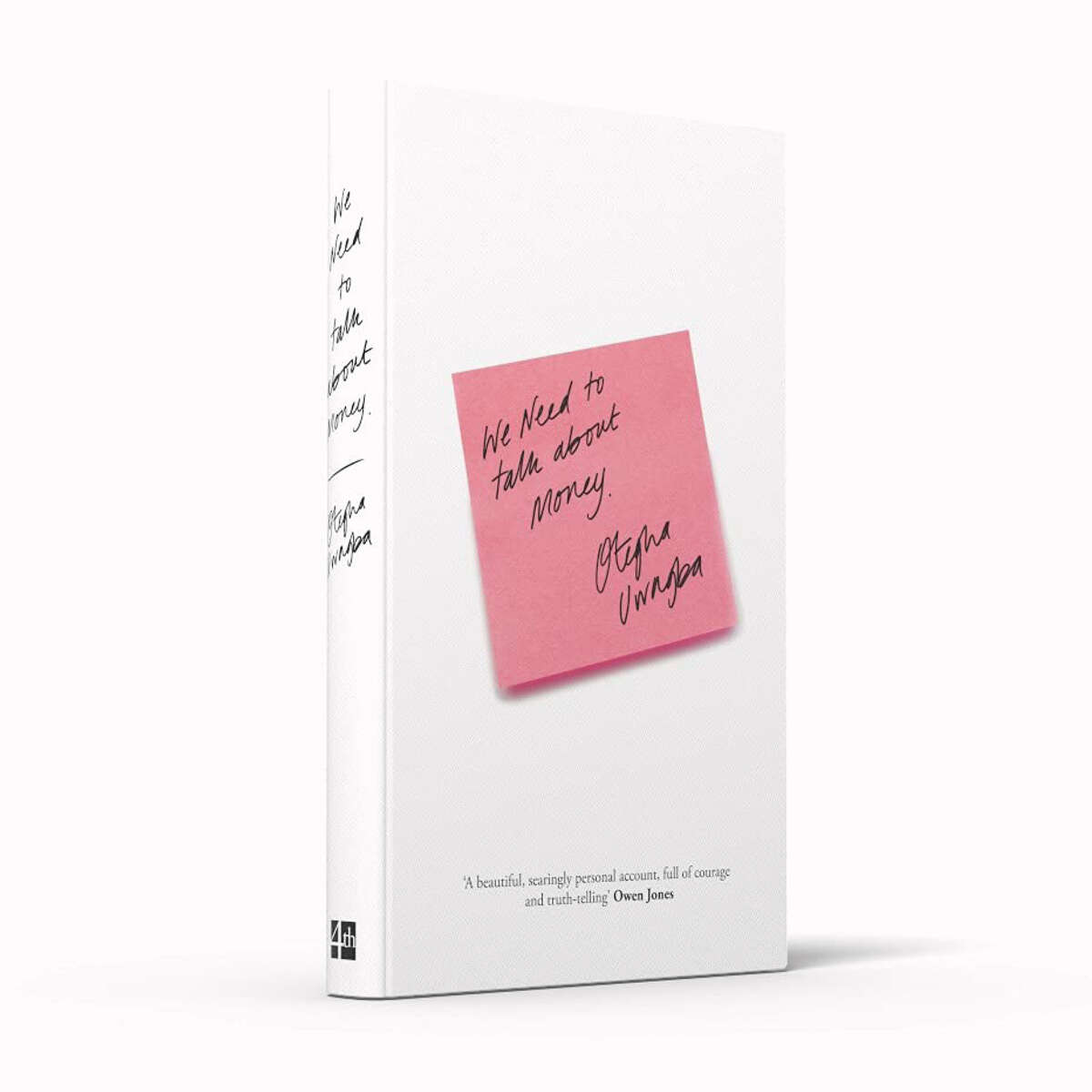
Otegha’s new book offers a smart take on finance that delves into both the personal and the political
Your mention of merit really strikes a chord – I think growing up we’re often told that if we just work hard enough we can have whatever we desire.
Exactly, and when we hit early adulthood and realise there are other factors at play, that can be really destabilising. There was a book I read as part of my research called The Class Ceiling [by Sam Friedman and Daniel Laurison], and in it the authors talk about the tendency of the upper middle classes to narrate their career or financial success purely in terms of talent and merit, without giving a full picture of the incredible privileges they had. It’s something I’m aware of, having been to private school – sure, I was on a scholarship, but it still gave me a huge leg up.
To pretend we live in a meritocracy does a disservice to the people who don’t have as much privilege. That’s something I’m always keen to get across: there are these structural barriers that control and dictate how much money we have, how much we have the potential to make, what our lives are going to be like, which often have nothing to do with personal merit, it’s just the situation we’re born into. Once we face up to that, then we can actually start doing something about it and talking about how money is made and spent and shared out in a system that’s fundamentally very unfair: that’s what I mean when I say we need to talk about money.
So where do we start? How do we break down the secrecy and shame that so often surrounds these conversations?
It starts, quite simply, with honesty. Because not being honest about money doesn’t help anyone. For example, I know how uncomfortable it is to be out with someone who’s a higher earner or bigger spender, and feeling like you need to keep up. You go out for an expensive meal and while they’re enjoying it you’re fretting over how you’re going to compensate until your next pay cheque comes in. It’s not worth it.
I don’t think I’ve ever been judgmental about people not having money, my judgment has often been reserved for people who had a lot of money. But nowadays, I just try to meet people where they are and not judge. And I have no shame about saying: “Oh, I can’t afford that holiday” or “I’ll just meet you guys for a drink after”. It’s not personal, it’s financial. We need to strip some of the emotive power out of money and see it for what it is: a commodity.
it's crucial to be honest about money – tell someone you can't afford that expensive holiday or meal

it's crucial to be honest about money – tell someone you can't afford that expensive holiday or meal
And as a side note, I do think it’s important to remember that friendship isn’t about spending money together. That’s been a great thing about the pandemic: just going for long walks or even talking for hours on the phone has left my friendships richer and deeper than going for brunch in a busy restaurant where you’re constantly distracted.
Why is it still so taboo for women to admit they desire money?
Because as much as feminism has made great advances in recent years, we are still conditioned to see women who are assertive about wanting money – or power – as somehow being ‘unfeminine’. We absorb those messages and project them onto people. For instance, there have been numerous studies debunking the misconception that part of the gender pay gap is down to the fact that women aren’t good at negotiating or asking for pay rises. In fact, women ask for raises at the same rate as men, they’re just more likely to be told no. I’ve heard it first-hand when researching my writing; one woman told me she’d asked for a raise and been threatened with a demotion, another said her manager told her the request was “inelegant”. It’s actually a form of gaslighting to deny women money and then also tell them it’s their fault for not asking. The bottom line is: women are still expected to be nice and agreeable and docile – demanding ‘more’ is at odds with that.
What’s the one lesson you want people to take away?
Talking about money is like ripping off a plaster. It might feel uncomfortable in the moment, but you will kick yourself if you don’t do it. Whether it’s in a professional setting, with a partner, with family – the worst thing you can do is avoid the conversation and then find yourself in a bad situation later, whether that means you’re being underpaid or you find yourself in a sticky financial dispute with someone. We enter into multiple financial agreements every week – some big, some small – but being able to look at them head-on and face up to the reality is crucial. I’d never suggest that simply talking about money is going to fix all your problems, but it’s a very good start. And it’s like a muscle – the more you exercise it, the easier it becomes.
